
Five Minutes Before Independence: The Night Jamaica Grew Up

I have always tried to be in Jamaica during the Independence season, between July 27 and August 12.
Why?
Because Jamaica’s Independence was never meant to be a single day.
Growing up, those dates seemed almost sacred.
Back then, Independence was not simply August 6.
It was a season.
A celebration.
A festival.
It was cart races, swimming competitions, canoe races, donkey races, cricket matches, football competitions, community fairs, concerts, and Festival Song competitions. It was nights when the music never seemed to stop, and people danced until, as we would say, “yuh foot dem feel like dem a guh drap off.”
I have searched for those experiences over the years, only to discover that many of them have quietly disappeared.
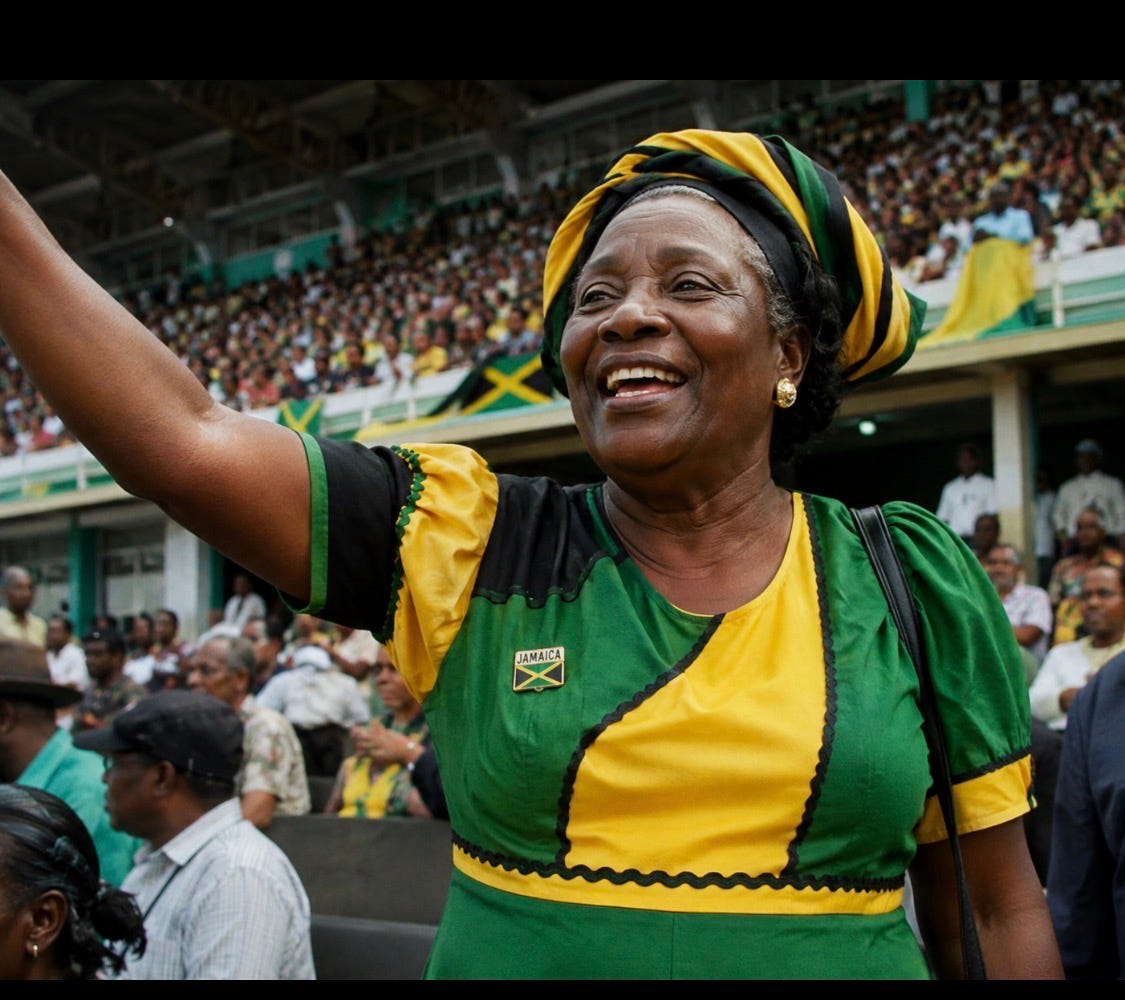
Today, when I think of Independence, too often what I see are sound systems set up on street corners and people drinking liquor and beer until the night is over.
There is nothing inherently wrong with celebration.
But somewhere along the way, we seem to have lost the community celebrations that brought everyone together.
I remember the fairs held in parks.
There were pie-eating contests.
Three-legged races.
Egg-and-spoon races.
Sack races.
Children competed for small prizes while parents laughed as they lined up for the 25- or 50-metre races, determined to prove they still had some speed left.
Winning hardly mattered.
Being together did.
Those memories remind me that Independence once belonged to everyone.
Perhaps that is why people often say those who grew up in the 1950s and 1960s knew how to enjoy themselves. Their celebrations were not built around consumption alone; they were built around participation. Everyone had something to do. Everyone had a place.
The night leading up to August 6 was not simply another party.
It was the party.
Yet as much as I remember the celebrations that surrounded Independence, I have often found myself reflecting on something I never witnessed.
I was born into independent Jamaica, but I never truly understood what happened during the final moments before our nation came into existence.
So I decided to follow the clock back to five minutes before midnight on August 5, 1962.
Five Minutes Before Midnight
There are moments in history when time seems to stand still.
For Jamaica, one of those moments began shortly before midnight on August 5, 1962.
At approximately 11:55 p.m., the National Stadium was already filled with an estimated 20,000 to 35,000 people. Among them were Princess Margaret, representing Queen Elizabeth II; the Earl of Snowdon; Jamaica’s first Prime Minister, Sir Alexander Bustamante; Opposition Leader Norman Manley; foreign dignitaries; military representatives; and thousands of Jamaicans who had gathered to witness the birth of a nation.
The National Parade had concluded.
The celebrations that had filled the evening gradually gave way to anticipation.
Every eye turned toward a single point in the stadium—the flagstaff.
Between 11:56 and 11:58 p.m., the atmosphere became one of solemn reflection as leaders from Jamaica’s major religious communities came forward to dedicate the new nation in prayer. Representatives of the Anglican, Roman Catholic, Protestant, and Jewish faiths all participated, symbolizing a country preparing to begin its journey united in hope.
Among the most memorable was the prayer offered by Bishop Percival Gibson, who concluded with these words:
“Into thy hands O Lord God our Father we commend our nation and people at this time. Look down O Lord upon our country and crown our independence with faith, hope and courage…”
As the prayers ended, a profound silence settled over the stadium.
After hours of music, celebration, speeches, and pageantry, thousands of people now stood quietly together, fully aware that they were only moments away from witnessing history.
At approximately 11:58:30 p.m., the first verse of “God Save the Queen” was played publicly for the final time as Jamaica’s national anthem. It was more than a song. It marked the formal conclusion of more than three centuries of British colonial rule, closing one chapter of Jamaica’s history as another was about to begin.
Then came one of the most dramatic moments of the entire ceremony.
At 11:59 p.m., the powerful floodlights surrounding the National Stadium were switched off.
The stadium was plunged into darkness.
Only the flagstaff remained illuminated.
Cheers echoed throughout the stadium.
A new nation had been born.
As I reflected on that historic moment, my mind drifted away from the dignitaries, the fireworks, and the official ceremony.
It wandered instead to Miss Mattie.
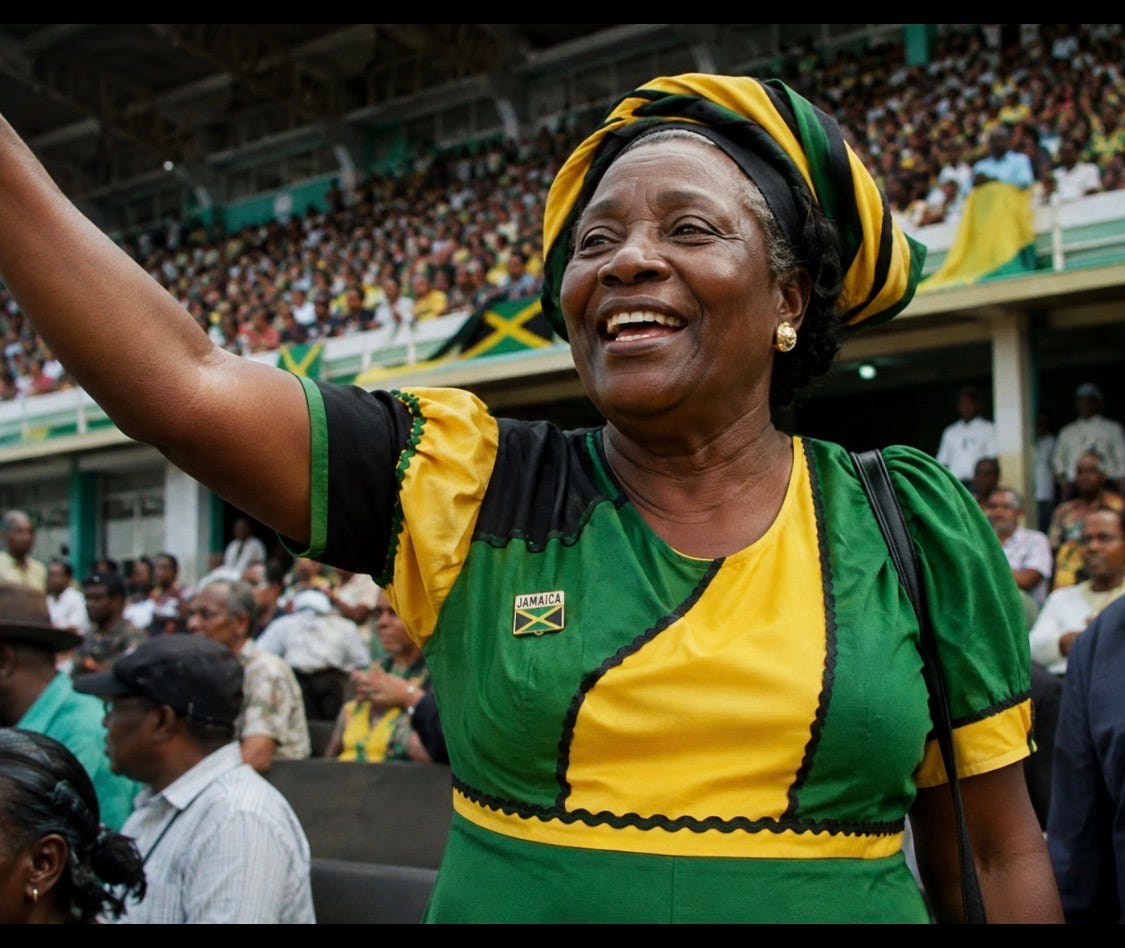
For the first time, I noticed her.
Not as a historical figure, but as one of the thousands of ordinary Jamaicans who gave Independence its soul.
I could almost see her sitting at her old manual Singer sewing machine, determined to finish the black, green, and gold dress she planned to wear to the National Stadium.
Time was running out.
The stitching wasn’t perfect.
One side of the waist sat much little higher than the other.
The gold fabric looked slightly faded, almost as though it had been washed one time too many.
The green was a little darker than it should have been.
But who cared?
Miss Mattie was representing.
She wasn’t wearing a designer dress.
She was wearing hope.
She was wearing pride.
She was wearing Jamaica.
And I imagine she walked into that stadium believing, as thousands of others did, that whatever tomorrow held, it would belong to them.
Sometimes history remembers the Prime Ministers, the Princess, the speeches, and the flags.
I hope it also remembers Miss Mattie—and the countless ordinary Jamaicans who stitched, cooked, marched, prayed, sang, danced, and dreamed their way into nationhood.
Because in many ways, they were the ones who truly wore Independence first.
For nearly one minute, thousands of people stood in near silence, their attention fixed on that single beam of light.
Then, at the stroke of midnight, the Union Jack was slowly lowered for the last time after flying over Jamaica for approximately 307 years.
Almost simultaneously, Jamaica’s new black, green, and gold flag began its ascent.
As it reached the top of the mast, the silence exploded into celebration.
Fireworks illuminated the Kingston sky.
Military bands played.
Cheers echoed throughout the stadium.
Miss Mattie was the first out of her seat.
You could spot her from almost anywhere in the stadium.
Wrapped in her handmade black, green, and gold dress, she stood waving, clapping, shouting, laughing, and crying all at once.
For the first time in her life, she was not simply celebrating an event.
She was celebrating her country.
She felt freedom.
She felt pride.
She felt hope.
And in that unforgettable moment, she stood for every ordinary Jamaican who believed that tomorrow would be better than yesterday.
A new nation had been born.
There is, however, one fascinating behind-the-scenes detail that many Jamaicans may not know…
A former cameraman with the Jamaica Film Unit later recalled that this historic ceremony had been carefully rehearsed beforehand. The plan was simple but precise: once the stadium lights were turned off, officials would quietly detach the Union Jack and attach the Jamaican flag so that the actual change would remain hidden from the audience until the exact moment of Independence.
But when the real ceremony unfolded, something unexpected happened.
The flag exchange appeared to take longer than anticipated.
Behind the scenes, those responsible reportedly became increasingly anxious, wondering whether everything would be completed before the clock struck midnight.
Fortunately, it was.
I have always found that recollection wonderfully human.
Even during one of the most carefully planned and historically significant moments in Jamaica’s history, while an entire nation waited in reverent silence, there were dedicated people working feverishly in the darkness, quietly hoping:
“Please let this work.”
Sometimes history is remembered through great speeches and famous leaders.
Sometimes history is remembered through great speeches and famous leaders.
Sometimes it is remembered through the unseen men and women behind the curtain who made sure that, when midnight arrived on August 6, 1962, Jamaica’s first flag rose exactly as history intended.
But history is also remembered through people like Miss Mattie.
She represented the market vendor, the cane cutter, the domestic worker, the teacher, the farmer, the fisherman, the factory worker, the nurse, the tradesman, the civil servant, and every Jamaican who may never have occupied a public office, yet carried the hopes of a new nation in their hearts.
They arrived at the National Stadium not as dignitaries, but as ordinary citizens.
They left as the first citizens of an independent Jamaica.
That night, the Union Jack came down.
The black, green, and gold went up.
And in the heart of every Miss Mattie, a nation rose with it.
Happy 64th National Independence everyone.