
The Missing Elevator

I stayed at the RIU this past week and recognized the massive numbers of guests who file in almost hourly during the daytime. It is unbelievable to see how many people arrive, how many pieces of luggage accompany them, and how quickly the lobby fills when buses pull up and release passengers.
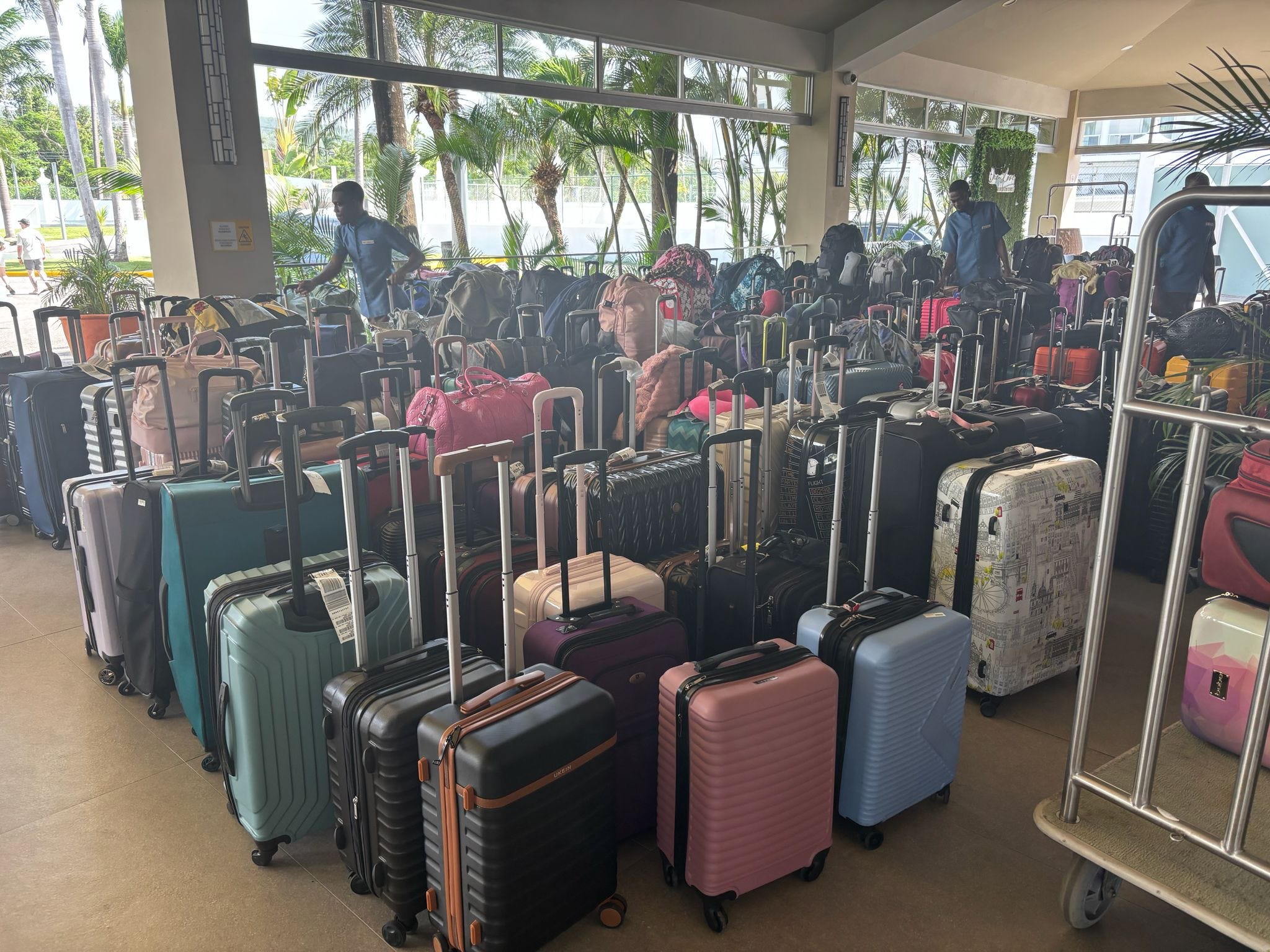
As I stood there watching, I noticed something else.
Despite the constant flow of guests, there were only one or two bellmen moving luggage to rooms.
They pushed those small carts loaded with suitcases for what seemed like five or six minutes at a time. The distance from the lobby to some of the room blocks is no joke. You might think you are simply getting your daily steps in, but some of those buildings are a considerable walk from the main reception area.
After observing for a while, I noticed something curious.
A bellman would leave with a loaded cart and would not return for 25 to 35 minutes.
At first, I thought little of it.
Then curiosity got the better of me.
I decided to follow one of the bellmen on a delivery run, with his knowledge of course. I was staying on the third floor and was not present when my luggage was delivered. I wanted to see how the process actually worked.
What I discovered surprised me.
When we reached the building, the bellman pushed the cart to the bottom of the stairwell.
Then he started unloading.
One by one, he lifted the suitcases onto his shoulders and carried them up two steep flights of stairs. Suitcases were sometimes 50 pounds.
Then he came back down.
Picked up another set.
And did it again.
And again.
Until the cart was empty.
I stood there watching and could not believe that this was the routine.
My immediate assumption was that perhaps he preferred the stairs because using the elevator would take longer.
So I went looking for the elevator.
There wasn’t one.
Trust me, even carrying nothing, I found those stairs challenging. Carrying luggage would have been another matter entirely.
As I watched, I found myself asking a question.
Was the hotel required to have elevators?
The answer appears to be more complicated than many people assume.
Jamaica’s building regulations establish standards for elevator installation and accessibility, but elevators are not required in every building. Depending on the structure, its height, design, and applicable building standards, stair access may satisfy the legal requirements.
In other words, the absence of an elevator does not automatically mean anything improper has occurred.
But that realization led me to a different question.
What happens when a building complies with the code, but the physical burden created by that design falls largely on workers?
At what point does the discussion move beyond architecture and become a discussion about work?
The absence of an elevator may satisfy applicable building standards. That was not what interested me most.
What interested me was the relationship between design and labor.
Every building is designed around a series of choices. Those choices affect how people move through a space, how services are delivered, and how work is performed. In this case, the absence of an elevator appeared to mean that the task of moving luggage from the ground floor to upper levels depended almost entirely on human effort.
Watching the process unfold made me think about something we rarely consider.
When guests arrive at a resort, they see the finished product. They see the room, the amenities, the landscaping, the entertainment, and the service. What they seldom see are the systems and routines operating behind those experiences.
Many of those routines have been carefully engineered for efficiency. Others may simply reflect decisions made when the buildings were first designed and constructed.
That observation raises a broader question.
To what extent should workplace design be considered part of occupational health and safety?
We often think about workplace safety in terms of accidents, injuries, hazards, and emergency procedures. Less attention is sometimes given to how the physical design of a workplace shapes the demands placed on workers day after day over many years.
As I watched that bellman move luggage up multiple flights of stairs, I found myself wondering where that conversation begins and where it ends.
Is this simply part of the job?
Is it an unavoidable consequence of the building’s design?
Or is it an example of a workplace demand that could potentially be reduced through different design choices, technologies, or operational practices?
I do not pretend to know the answer.
What I do know is that observing the process caused me to think less about elevators and more about work itself.
This is where government enters the conversation.
The Government of Jamaica has a responsibility not only to grow the tourism industry, but also to protect the workers who make that industry possible.
Watching a bellman carry heavy luggage up multiple flights of stairs throughout the day raises broader questions about how occupational health and safety is defined and applied. Building standards, workplace design, worker protection, and long-term physical strain are often discussed separately. Experiences such as this suggest they may be more connected than we sometimes recognize.
Tourism is one of Jamaica’s most important economic sectors. The people who work in it deserve more than our gratitude. They deserve thoughtful consideration of how workplace environments are designed and how those designs shape the daily realities of work.
Long after I stopped thinking about the hotel itself, I kept thinking about that bellman disappearing up those stairs, returning for another load, and then doing it again.